The Stages of Self-Actualization
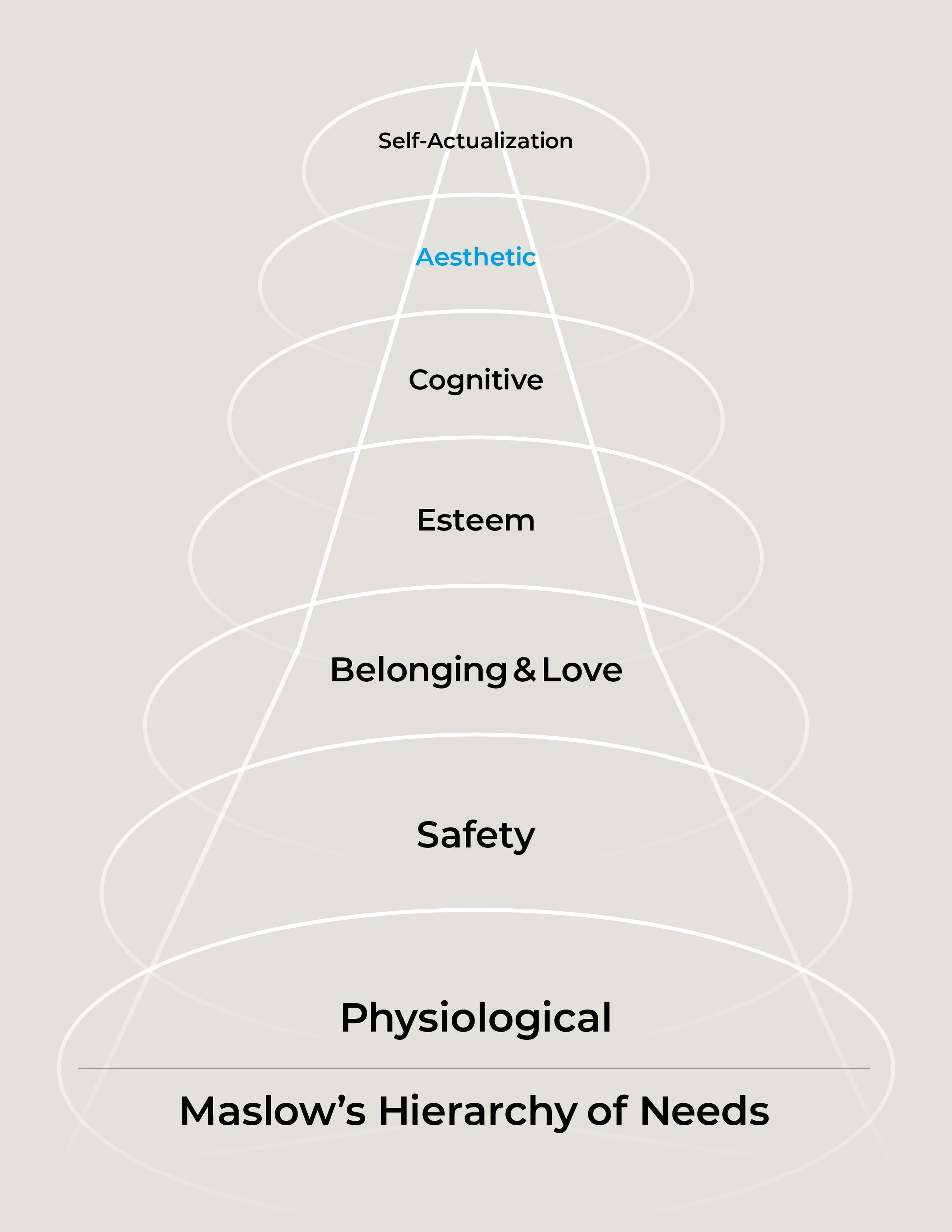
Setting Priorities: The role of art in our personal evolution ranks high among high-achievers.
The Hierarchy of Needs is a thesis proposed by American psychologist Abraham Maslow in his 1943 paper “A Theory of Human Motivation” in the journal Psychological Review. Maslow proposed the theory based on his observations of humans’ innate curiosity, which describes the stages of human advancement and ascendance to higher levels of consciousness. The classification system reflects the universal needs of society as its baseline, evolving to more acquired emotions once mastery of each prior stage has been attained. The scale is used to explain how effort and motivation are correlated in human behavior. The goal in Maslow’s hierarchy is to acquire the stage of self-actualization, which is only one level above aesthetic, described as the appreciation of art, symmetry, and beauty.

The Sky Is the Limit: Successful individuals prioritize what matters, ignore the rest, and possess a clear understanding of the self.
Characteristics of self-actualized
A self-actualizer is a person living creatively and fully using their potential. It’s reflected in the passion for self-fulfillment, for an individual to become actualized in their potential. Maslow considered self-actualizing people to possess “an unusual ability to detect the spurious, the fake, and the dishonest in personality, and in general to judge people correctly and efficiently.” In his studies, Maslow found that the self-actualized share similarities. He believed that each of them had somehow managed to find their core nature that is unique to them, one of the primary goals in life. Whether famous or unknown, educated or not, rich or poor, self-actualizers tend to fit the following profile according to Maslow*:
Efficient perceptions of reality. Self-actualizers are able to judge situations correctly and honestly. They are very sensitive to the superficial and dishonest.
Comfortable acceptance of self, others and nature. Self-actualizers accept their own human nature with all its flaws. The shortcomings of others and the contradictions of the human condition are accepted with humor and tolerance.
Reliant on own experiences and judgment. Independent, not reliant on culture and environment to form opinions and views.
Spontaneous and natural. True to oneself, rather than being how others want.
Task centering. Most of Maslow’s subjects had a mission to fulfill in life or some task or problem ‘beyond’ themselves (instead of outside themselves) to pursue. Humanitarians such as Albert Schweitzer are considered to have possessed this quality.
Autonomy. Self-actualizers are free from reliance on external authorities or other people. They tend to be resourceful and independent.
Continued freshness of appreciation. The self-actualizer seems to constantly renew appreciation of life’s basic goods. A sunset or a flower will be experienced as intensely time after time as it was at first. There is an “innocence of vision”, like that of a child.
Profound interpersonal relationships. The interpersonal relationships of self-actualizers are marked by deep loving bonds.
Comfort with solitude. Despite their satisfying relationships with others, self-actualizing people value solitude and are comfortable being alone.
Non-hostile sense of humor. This refers to the ability to laugh at oneself.
Peak experiences. All of Maslow’s subjects reported the frequent occurrence of peak experiences (temporary moments of self-actualization). These occasions were marked by feelings of ecstasy, harmony, and deep meaning. Self-actualizers reported feeling at one with the universe, stronger and calmer than ever before, filled with light, beauty, goodness, and so forth.
Socially compassionate. Possessing humanity.
Few friends. Few close intimate friends rather than many perfunctory relationships.
Gemeinschaftsgefühl. According to Maslow, the self-actualizers possess “Gemeinschaftsgefühl”, which refers to “social interest, community feeling, or a sense of oneness with all humanity.”
*Excerpted from Wikipediaarticle: Self-actualization
