Framing Freedom: How Frederick Douglass Used Photography to Combat Racism
Frederick Douglass (1818-1895), quarter-plate ambrotype, c. 1856.
Photographer unknown. National Portrait Gallery, Smithsonian Institution.
Famed abolitionist Frederick Douglass was the most photographed American of the 19th century. For Douglass, the camera was a potent weapon in the fight for Black rights and freedoms.
“Frederick Douglass knew that any image would be deconstructed, so everything about Frederick Douglass says, ‘I’m middle class, I’m educated, I’m equal, I’m worthy,’” says Lonnie Bunch, Secretary of the Smithsonian Institution.
After escaping slavery in 1838, Douglass became a brilliant writer and orator. However, he also recognized that photography could accurately represent African Americans at a time when racist caricatures dominated popular culture.
Between 1841 and 1895 — when photography was costly and time-consuming — Douglass sat for more than 160 portraits. In their illustrated biography, Picturing Frederick Douglass, authors John Stauffer, Celeste-Marie Bernier, and Zoe Trodd explain that Douglass viewed photography as a “democratic art” capable of asserting Black humanity and countering blackface minstrelsy.
“Poets, prophets and reformers are all picture-makers — and this ability is the secret of their power and of their achievements,” Douglass noted in 1861. “They see what ought to be by the reflection of what is, and endeavor to remove the contradiction.”
Historians emphasize that Douglass’ legacy is inseparable from his portraits, which were often juxtaposed with horrifying images of those brutalized by slavery to create a powerful anti-slavery narrative. Ultimately, Douglass used every medium at his disposal — writing, speeches, and photography — to assert equality and move the nation forward.
Frederick Douglass, photographed by George Kendall (G.K.) Warren, c. 1876. Albumen print created between 1884 and 1890. Library of Congress Prints and Photographs Division.
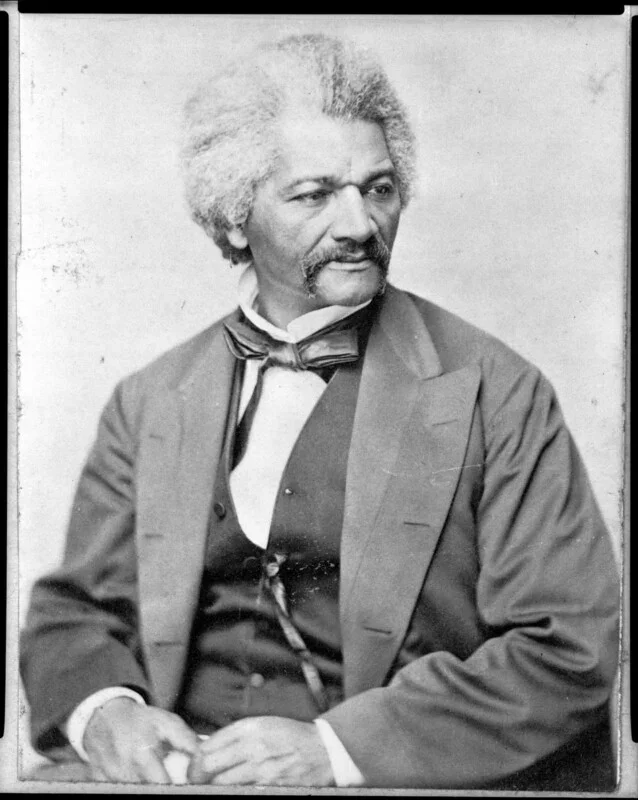
Frederick Douglass, albumen print, c. 1870, by photographer George Francis Schreiber.
Library of Congress Prints and Photographs Division.
